
Repair or Junk
Junk It, Sell It or Donate It: How to Decide in Washington
Your car needs a repair that costs more than you want to spend, or it has been parked so long you have stopped thinking of it as a car. You have four ways out: sell it yourself, trade it in, donate it or junk it for cash. Each one fits a different situation, and the wrong choice can cost you weeks of hassle or a tax deduction that turns out smaller than you expected.
This guide walks through each option, including the cases where junking is not your best move. Whatever you choose, Washington asks you to do the same things after the car leaves: file a Report of Sale and take your plates. Our Washington junk car paperwork guide covers those steps in full.
Short answer
Junk the car for cash if it does not run, the repair costs more than it is worth, or you need it gone this week. Sell it yourself if it runs well and has a clean title. Donate it only if you itemize deductions: the IRS usually limits the deduction to what the charity sells the car for.
Start with one question: is the car worth fixing?
Before you compare buyers, decide whether the car has a future on the road. That one answer usually points you to the right option.
Compare the repair quote with what the car is worth after the repair
Get a written repair quote, then look up what the same year, make and model sells for in good running condition. If the repair costs close to, or more than, what the car will be worth once it is fixed, the money is better spent on your next car. A pricing guide only helps if you match the same year, model, condition and options, so be honest about mileage, rust and dents.
Signs the car is near the end of its road life
- The engine or transmission has failed, or a shop says it needs to be rebuilt.
- Several expensive repairs are due at once, not just one.
- There is rust in the frame or underbody, not only on the paint.
- It has been in a crash and the damage reaches the frame, the airbags or the suspension.
- It has been parked for months or years, with a dead battery and flat tires.
- You no longer trust it to get you to work and back.
Count your time and stress, not only dollars
Selling a car privately can take weeks of listings, messages, no-shows and test drives. If the car is blocking your driveway, sitting in an apartment lot or you are moving soon, a fast and certain sale can be worth more to you than a slightly higher price that may never show up.
Junk, private sale, trade-in or donation: side by side
Here is how the four options compare. The money row is general, because every car is different.
| Option | Junk for cash | Private sale | Trade-in | Donation |
|---|---|---|---|---|
| Speed | Fast. Same-day pickup is often possible. | Slowest. Depends on finding a buyer. | Fast, but only when you buy another car. | Depends on the charity's pickup schedule. |
| Your effort | One call or form. We tow it. | Listing, photos, calls, showings, test drives. | A visit to the dealer. | A call or form, then tax paperwork. |
| Does it have to run? | No. | Buyers usually want it to run. | Dealers set their own rules. | Charities set their own rules. |
| Washington paperwork | Title or accepted affidavit, then your Report of Sale. | Title, Bill of Sale, Report of Sale. | A dealer may file the Report of Sale for you. You must confirm it was filed. | Title, then your Report of Sale. |
| What you get | Cash on the spot. | Often the most money for a car that runs well. | Credit toward your next car. | A possible tax deduction, only if you itemize. |
All four end the same way in Washington. DOL lists selling, trading to a dealer, donating, gifting and giving the car to a wrecking yard as transfers you must report, and RCW 46.12.650 gives you five business days to do it.
When junking it for cash makes sense
Junking means selling the car to a buyer like us who pays for it as it is, tows it away and sends it on for parts and metal recycling. It is the right call more often than people expect.
It does not run
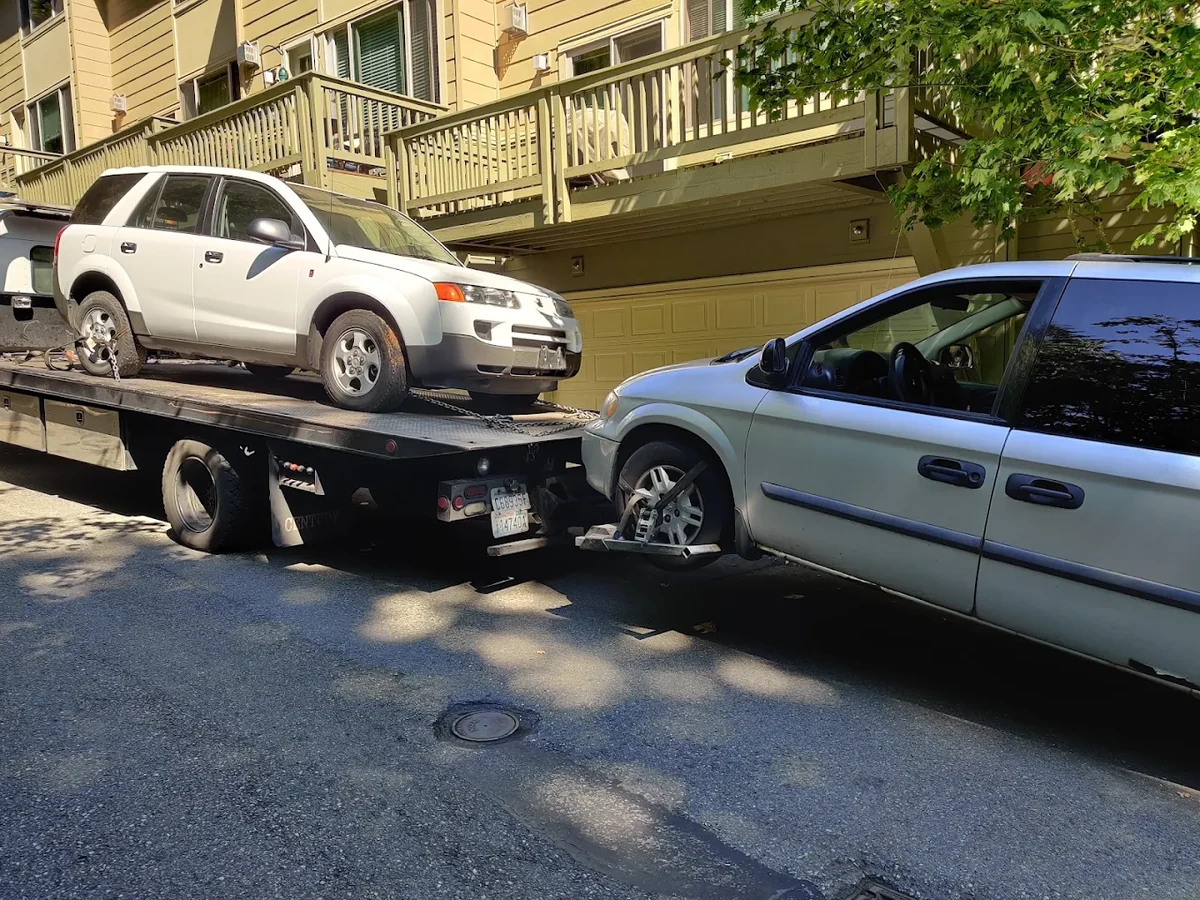
Private buyers rarely want a car they cannot drive home. We load cars with dead batteries, blown engines and failed transmissions on a flatbed. See non-running car removal.
The repair is not worth it
When the quote is bigger than the car's value, junking turns a problem into cash. We can pick it up from your home or from the repair shop.
You need it gone now
Moving, selling a house or clearing a parking spot? We buy any car in 24 hours or less, and same-day pickup is often possible.
Its value is mostly metal
Old, rusted or stripped cars are worth what their parts and metal are worth, and that is exactly what we buy. See scrap car removal.
How it works with us
Call (206) 941-0612 or send the form with the year, make and model. We call you back within 4 hours and give you an offer. Our driver comes at a time that suits you, checks the paperwork, loads the car and pays you cash on the spot. The towing is free. What we offer depends on the year and model, condition, demand for its parts, weight and size, and towing distance. You can read more on how your offer is worked out.
If a stolen catalytic converter is what pushed you to this decision, read what to do when your catalytic converter is stolen first.
When a private sale is the better choice
If the car runs well, has a clean title in your name and is worth clearly more than its parts and metal, selling it yourself usually brings the most money. It also takes the most work. Here is how to do it properly in Washington.
Get the title ready
Washington DOL says a vehicle must have a valid title before it can be sold. If you cannot find it, DOL accepts an Affidavit of Loss/Release of Interest or an Affidavit in Lieu of Title. If a lender still holds the title, read selling a car with a lien in Washington.
Meet buyers safely
DOL recommends that buyer and seller meet at a vehicle licensing office to collect payment and sign over the title. If that is not possible, it suggests a well-lit public place or bringing a trusted third person. Before the sale, remove anything with your name, address or photo from the car.
Sign the title and a Bill of Sale
DOL says you and the buyer both sign a Bill of Sale, which lists the vehicle, the buyer and the seller. Each of you keeps a copy.
Take your plates, then report the sale
DOL says sellers must remove the plates. Then file your Report of Sale within five business days, online or at a licensing office (DOL lists the fee as $18). Step-by-step guide.
One more note from DOL: if the car is not currently licensed, the buyer should buy a trip permit before driving it away.
What about trading it in?
A trade-in is the simplest option if you are buying another car from a dealer anyway. You hand over the keys and the title, and the dealer takes the value off your new purchase. You give up some of the price you might get selling privately in exchange for speed and convenience.
Two things to know in Washington. First, DOL says a registered Washington dealer may file the Report of Sale on your behalf, but it is still your responsibility to confirm the report was submitted. Second, a dealer has to want the car. Cars that do not run, or need big repairs, may get a very low trade value or none at all. In that case, junking it separately and taking the cash can make more sense.
Donating a car: what the tax deduction really is
Donating a car can be a good way to support a cause you care about. But many people donate expecting a large tax break and get much less. The IRS rules for donated vehicles are in Publication 4303 and Publication 526. Here is what they say, in plain English.
You must itemize
The IRS says that generally, to deduct a charitable contribution, you must itemize deductions on Schedule A. The new deduction for people who do not itemize, starting with 2026 returns, covers cash contributions only (IRS Publication 6196), so a donated car does not qualify.
Usually limited to the sale price
If you claim more than $500 and the charity sells the car, your deduction is generally limited to the gross proceeds the charity receives from the sale, not the value you looked up.
The $500 rule
If the charity sells the car for $500 or less, you can deduct the smaller of the car's fair market value on the day you donated it, or $500, with the right written acknowledgment from the charity.
When fair market value applies
You may deduct fair market value if the charity makes significant use of the car, materially improves it, or gives or sells it to a person in need at a price well below its value. The charity has to certify this in writing.
The paperwork the IRS expects
- Check the charity first. Only qualified organizations can receive deductible gifts. Use the IRS Tax Exempt Organization Search tool.
- Form 1098-C. For a deduction over $500, you must get Form 1098-C or a similar written statement from the charity within 30 days of the sale, and attach Copy B to your return. Without it, the IRS says you cannot deduct the contribution (see Form 1098-C).
- Form 8283. If your non-cash gifts for the year total more than $500, you generally also attach Form 8283.
Washington still wants a Report of Sale
A donation is a transfer like any other. DOL lists donating among the transfers you must report, and the five-business-day deadline in RCW 46.12.650 applies. The IRS guide also recommends that donors handle the title transfer themselves and remove the plates before donating, unless state law says otherwise. Do not rely on the charity or its towing company to file for you.
When donating is the better choice
Donate if you itemize, the charity will actually use the car or give it to someone in need, and supporting that cause matters more to you than cash. If you take the standard deduction, or the charity will simply sell the car at auction, cash in hand is often worth more.
A simple way to decide
Work down this list and stop at the first answer that fits.
It runs well and is worth more than its parts?
Sell it yourself for the best price, or trade it in if you are buying from a dealer and want it done fast.
You itemize and the charity will use the car?
Donating can make sense. Check the charity, get Form 1098-C and file your Report of Sale.
It does not run, needs a big repair or has to go this week?
Junk it for cash. You get paid on the spot, the towing is free, and you skip the listings and test drives.
Whatever you choose, finish the job the Washington way: sign the title or the accepted affidavit, take your plates, and file your Report of Sale within five business days. Our paperwork guide has the full checklist.
Still not sure? Call us at (206) 941-0612. We are open 7 days a week, 8 AM to 11 PM. Tell us about the car and we will give you an honest offer, so you can compare it with your other options. If it does not run, it does not matter to us.
Common questions
Official sources
- Washington DOL: Sell a vehicle (Report of Sale, plates, title, Bill of Sale, meeting buyers)
- RCW 46.12.650: Report of sale within five business days, including donations
- IRS Publication 4303: A Donor’s Guide to Vehicle Donation
- IRS Publication 526: Charitable Contributions
- IRS Form 1098-C: Contributions of Motor Vehicles, Boats, and Airplanes
- IRS Publication 6196: Charitable Contribution Deduction Tips for Non-Itemizers (2026)
- IRS Tax Exempt Organization Search
This post summarizes official Washington guidance as of October 28, 2026. It is general information, not legal or tax advice. Rules and fees can change, so check the sources above for your situation.
Keep reading
- Washington Junk Car Paperwork GuideThe full guide this post is part of
- What to Do After You Junk Your Car in Washington
- How to Sell or Junk an Inherited Car in Washington
- Can You Sell or Junk a Car With a Lien in Washington?
- Catalytic Converter Stolen? Your Options in Washington, Including Selling the Car
4.9 out of 5 from 160 Google reviews · Licensed & insured · 20+ years in business
Andy matched the best offer I got for my 2001 Odyssey with a dead transmission. He came and towed the van to within 30 minutes of talking to him and was very professional and efficient.
I had an old car I needed removed after selling my house. They were there to pick it up in less than an hour and paid me on the spot. No hassle, sign the title and go. Will be using again as I have another vehicle that needs to go! Thank you guys! =)
I was in need of a quick answer to my dead car. I called 4 places over 2 days. They were all super slow and in other states. Called Cash for Cars and it was done in an hour. Was there on time to the minute. I'm 50. This isnt my first time doing this. Never was it easier or faster.
If you have any questions please call us at 206-941-0612