
Washington Paperwork
How to Sell or Junk an Inherited Car in Washington
When a parent, spouse or relative dies, their car is often one of the last things anyone has the energy to deal with. It sits in the driveway or the garage, the tabs run out, and nobody is sure who is allowed to sign the title.
This guide walks through how Washington handles a vehicle when the owner has died: who can sell it, which Department of Licensing (DOL) papers fit your situation, and how to junk the car for cash if it is not worth keeping. It is part of our Washington junk car paperwork guide.
Short answer
In Washington you can sell or junk a car for someone who has died if you legally own it now or are legally allowed to act for them. Which papers you need depends on the estate: a personal representative’s court papers if there is probate, a DOL Affidavit of Inheritance plus a death certificate if there is not, or just a death certificate for a surviving joint owner.
Before you do anything with the car
A few minutes of gathering now saves a second trip to the licensing office later. Before you call anyone about the car, try to find these things:
The title
Look in a file cabinet, safe or the glove box. Note whose names are on it and how they are joined. If the title says the owners hold it in joint tenancy, the rules are simpler (more on that below).
Copies of the death certificate
Almost every route DOL accepts asks for a copy of the death certificate. Ask for extra copies when you order them, because banks and other offices will want one too.
Any probate papers
If a will is going through court, find out who the personal representative is (the executor or administrator) and whether letters have been issued.
Any loan on the car
If a bank or credit union is listed as the legal owner, its release is needed before the car can change hands. See selling a car with a lien in Washington.
You do not need everything on this list before you call us. If some papers are missing, tell us what you have and we will tell you what we need for a pickup.
Who is allowed to sell or junk the car?
Washington DOL’s Sell a vehicle page says you may sell on behalf of someone who has died as long as you legally own the car or are legally allowed to act on their behalf. The state rule on deceased owners, WAC 308-56A-335, sets out which papers prove that in each situation:
| Your situation | Who signs | Papers DOL lists |
|---|---|---|
| Joint owner, joint tenancy shown on the title | The surviving owner | A copy of the death certificate |
| Surviving spouse with a community property agreement | The surviving spouse | A copy of the death certificate and a copy of the community property agreement |
| Estate in probate | The personal representative | Letters testamentary, letters of administration, or a certificate from the county clerk |
| No probate | The heir | A copy of the death certificate plus an Affidavit of Inheritance or an affidavit of succession |
If more than one of these could fit, or the family is not sure whether the estate needs probate, a vehicle licensing office can look at your papers and tell you which route applies. DOL lists its vehicle phone line as (360) 902-3770.
When there is probate: the personal representative signs
Probate in Washington goes through the superior court of the county, for example King County Superior Court, Pierce County Superior Court or Snohomish County Superior Court. The court appoints a personal representative to handle the estate. That person is the one who signs for the car.
Under WAC 308-56A-335, the personal representative has two options:
Title the car in the estate’s name
The personal representative signs to release the deceased owner’s interest, and the car is titled while the estate is being settled. The title then reads “Estate of” followed by the owner’s name. A copy of the court order appointing or confirming the personal representative goes with the application.
Release it straight to a new owner
The personal representative can also release the ownership so the car transfers into the name of the new owner. For a car that is only worth scrap, this is often the simpler path.
Either way, the papers that prove the personal representative’s authority are letters testamentary, letters of administration, or a certificate from the county clerk. Bring a copy when you sell the car, and keep the original with the estate file.
No probate: the DOL Affidavit of Inheritance
Many families never open probate, especially when the estate is small. For a car in that situation, DOL uses the Affidavit of Inheritance/Litigation (form TD-420-041). The inheritance section is for when no executor or administrator has been appointed.
What you certify when you sign it
- The registered owner died on a stated date.
- The estate did not need administration, and no letters of administration or letters testamentary have been issued to anyone.
- The car was not left by will to anyone other than the person signing.
- No relative with a prior right to inherit survives, except anyone you name on the form.
- Provision has been made to pay the deceased person’s debts.
What you hand in with it
The form says to submit it with the title and a copy of the death certificate. An Odometer Disclosure Statement or a Release of Interest may also be required, so ask the licensing office when you go.
Signing it
Sign in front of a notary, or in front of a Washington vehicle licensing agent. The form says you do not need a notary if you sign in front of a vehicle licensing agent, because the agent can certify your signature.
If you are not sure whether you are the right person to sign, for example because a brother or sister would have an equal claim, talk to the family first. The affidavit asks you to name anyone with a prior right, so it is easier when everyone agrees before you go.
The small estate affidavit (RCW 11.62)
Washington also has a small estate process in RCW 11.62.010. It lets a successor collect personal property, such as a car, without probate when the estate is small. DOL’s rule lists this “affidavit of succession” as one of the papers it accepts for an estate that is not being administered.
The law sets out conditions. Among them:
- At least 40 days have passed since the death.
- The estate is worth no more than $100,000, after liens and not counting the surviving spouse’s or domestic partner’s community property share.
- The person who died lived in Washington.
- No one has applied to be, or been appointed, personal representative anywhere.
- Debts, including funeral and burial costs, are paid or provided for.
- The other successors got written notice at least 10 days before.
The same law says a government agency that issues ownership certificates must issue a new one to a successor who brings proof of death and a proper affidavit. For most families junking an older car, the DOL Affidavit of Inheritance is the more common form, but this route exists if a lawyer or the family is already using it for other property.
Surviving spouse or joint owner
These are usually the easiest cases, because the person who signs was already part of the ownership.
Joint owner on the title
If the title shows the owners held it in joint tenancy, WAC 308-56A-335 says the surviving owner can transfer the car into their own name. DOL lists a copy of the death certificate as the paper needed.
Spouse with a community property agreement
A surviving spouse who signed a community property agreement with the person who died brings a copy of the death certificate and a copy of that agreement.
Spouse without an agreement
If there is no community property agreement and no joint tenancy on the title, the spouse usually goes through one of the other routes: probate, the Affidavit of Inheritance or the small estate affidavit.
Not sure how the title is worded? Bring it to a vehicle licensing office or read it to us over the phone, and we will tell you what we would need for a pickup.
Junking an inherited car with us
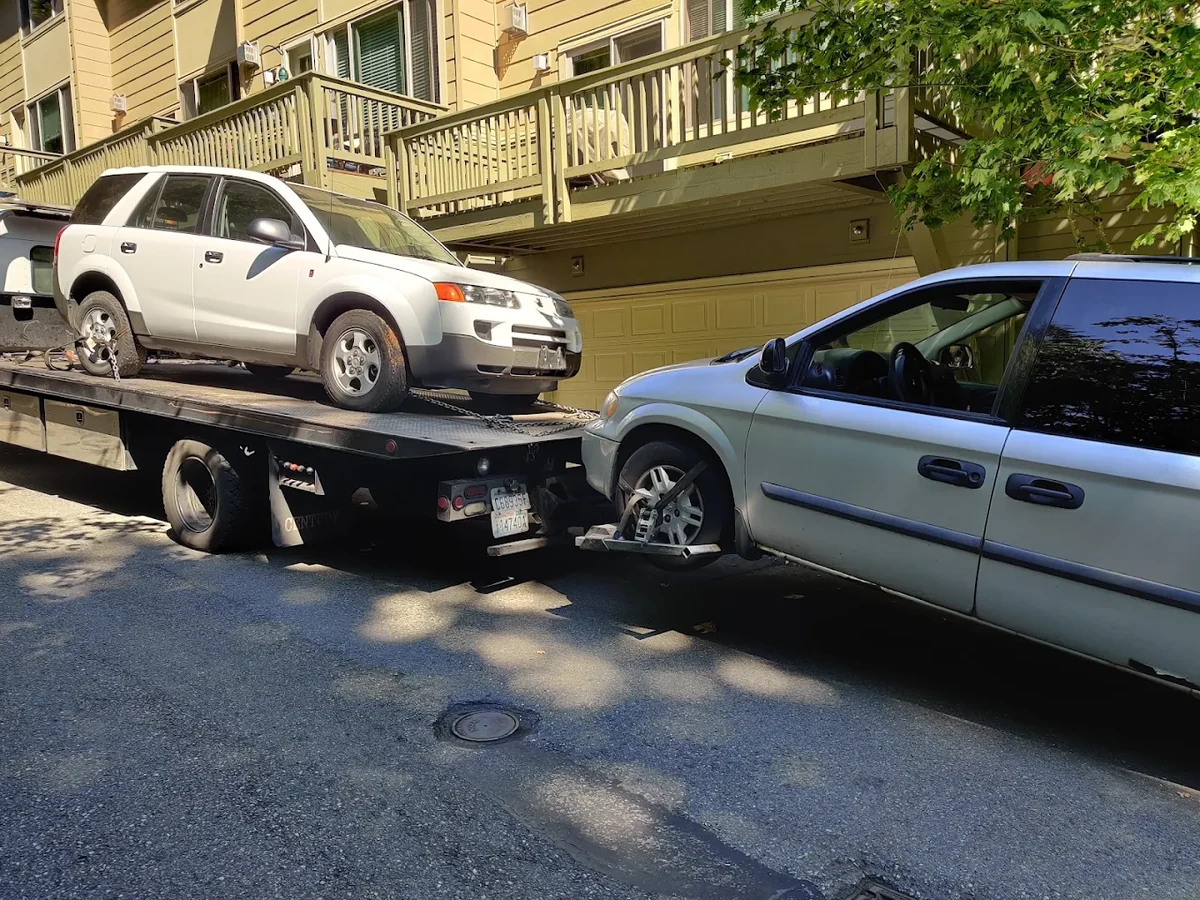
A lot of inherited cars are older and have been parked for months. Flat tires, a dead battery and expired tabs are normal. If the car is not worth fixing or keeping, we buy it as it is, tow it away for free and pay cash on the spot.
Call us or send the form
Call (206) 941-0612 or send the pickup form. Tell us whose name is on the title and what papers you have. We call back within 4 hours of a form request.
Get the right paperwork together
For a pickup we need one of these: the Title, an Affidavit in Lieu of Title, or a Junk Vehicle Affidavit. When the owner has died, it also has to be signed by the person who now has the right to sign, with the papers that show it.
Pick a pickup time
We are open 7 days a week, 8 AM to 11 PM, and same-day pickup is often possible. A car that does not run is not a problem for our flatbeds. See how our pickup works.
We load it and pay you
Our driver checks the paperwork, loads the car and pays you in cash. Your offer depends on the year and model, condition, demand for parts, weight and size, and towing distance. More on how your offer is worked out.
Title lost? DOL also accepts an Affidavit of Loss/Release of Interest when the title cannot be found. Our selling a car without a title page explains how we help.
If you live out of the area and a family member nearby is handling the car, call us first. We can talk through who needs to be there on pickup day and which signed papers they need to hand over.
After the pickup: Report of Sale and plates
Once the car is gone, two DOL steps close things out. Both are on the Sell a vehicle page:
File a Report of Sale within 5 days
DOL says sellers are legally obligated to file a Report of Sale within 5 days of the sale. It protects the seller from towing charges and liabilities tied to the car after the sale. DOL lists a $18 fee for filing by mail or in person. If the car passes to a family member as a gift or inheritance instead of being sold, DOL says to enter a sale price of zero.
Take the plates off
DOL says sellers are legally obligated to remove the license plates. The plates can move to a vehicle of the same type, or you can turn them in at a vehicle licensing office. This protects you from parking tickets, camera tickets and toll bills on that plate.
For a step-by-step walkthrough of both, read what to do after you junk your car in Washington. Once the car is gone, it is also a good time to call the insurance company about the policy on that vehicle.
Clearing out a loved one’s car
A car often holds more than people expect: papers, photos, a favorite jacket. Take your time with this part before pickup day.
- Check the glove box, door pockets, center console, under the seats and under the trunk floor.
- Take out the registration, insurance cards and any service records.
- Remove a garage door opener, parking permit or toll pass if there is one.
- Look for keepsakes: sunglasses, notes, photos, a keychain someone might want.
- Take the license plates off.
- Put the signed papers in one envelope for our driver.
If something gets missed, tell our driver before the car is loaded. One of our customers wrote that our driver helped her empty forgotten things out of the trunk of her mom’s car before he towed it.
Common questions
Official sources
- Washington DOL: Affidavit of Inheritance/Litigation (form TD-420-041)
- WAC 308-56A-335: Titling when a vehicle owner is deceased
- RCW 11.62.010: Small estate affidavit
- Washington DOL: Sell a vehicle (Report of Sale, plates, selling for someone deceased)
- Washington DOL: Affidavit of Loss/Release of Interest
This post summarizes official Washington guidance as of October 28, 2026. It is general information, not legal or tax advice. Rules and fees can change, so check the sources above for your situation.
Keep reading
- Washington Junk Car Paperwork GuideThe full guide this post is part of
- What to Do After You Junk Your Car in Washington
- Can You Sell or Junk a Car With a Lien in Washington?
- Catalytic Converter Stolen? Your Options in Washington, Including Selling the Car
- Junk It, Sell It or Donate It: How to Decide in Washington
4.9 out of 5 from 160 Google reviews · Licensed & insured · 20+ years in business
This gentleman was very understanding and was willing to give me the best deal for my mom's wrecked vehicle. He showed compassion and helped me empty the trunk of things that were forgotten about. He showed up within 20 minutes of our phone call. He is skilled at getting into tight spaces and doing the removal within minutes. I recommend him and his services to anyone that needs an honest opinion and respects value in a hard days work. This kind of customer care is hard to find these days. Thank you Sir, for helping me say goodbye to bad memories. Stay blessed ❤️
This was such an easy and stress-free experience! I just texted a photo of the title and within about an hour the car was towed away. It was my 83 year old dad's car and he wasn't feeling well, so they were even fine with me bringing the signed title to the tow site and handling things for him. Once the driver was there, it was literally like 3 minutes and all was done. It's wonderful to work with a local business and not a national chain.100% recommend!
I had an old car I needed removed after selling my house. They were there to pick it up in less than an hour and paid me on the spot. No hassle, sign the title and go. Will be using again as I have another vehicle that needs to go! Thank you guys! =)
If you have any questions please call us at 206-941-0612