
Recycling and How It Works
Is Junking a Car Good for the Environment?
If you care about this question, you have likely seen big, confident percentages online. We are not going to give you any, because we have no verified numbers of that kind to stand behind.
What we can do is compare your real options and show what the state and federal rules cover, so you can make a sensible call.
Short answer
Compared with a car that sits and leaks or gets dumped, sending it through licensed recycling is the better choice. Fluids are drained, tires and batteries are removed, and the metal is melted for reuse. If a car is safe and still has useful life, though, keeping it on the road with a new owner may be better still.
Your options compared
| What happens to the car | Environmental side | Rules to know |
|---|---|---|
| Sold or donated, still driven | Gets more use out of a car that already exists, if it is safe and sound | Report of Sale still applies |
| Sent to a licensed recycler | Fluids drained, tires and batteries removed, metal melted and used again | Hauler and recycler licensing |
| Sits for years outdoors | Old fluids and a battery stay in a car that may start to leak | Seattle and other cities restrict junk vehicle storage |
| Parted out at home | Reuses parts, but you take on fluids, refrigerant, tires and scrap | See the table below |
| Abandoned or dumped | The worst case | Abandoning a junk vehicle is a gross misdemeanor with restitution |
If you are deciding between these, read junk, sell or donate.
What the rules say about the messy parts
A car is full of things you should not handle casually. Each of these has a rule behind it:
| Item | What the source says | More help |
|---|---|---|
| Antifreeze | “Any discharge of spent antifreeze to the environment constitutes disposal” (WAC 173-303-522) | Oil and antifreeze |
| Used oil | Mixing it with other waste means it cannot be managed as used oil | Oil and antifreeze |
| Battery | May not be knowingly disposed of except through set channels. Fine up to $1,000 each (RCW 70A.205.505) | Car battery disposal |
| Tires | Disposal outside a designated site carries a civil penalty of $200 to $2,000 per offense (RCW 70A.205.400) | Old tires |
| Refrigerant | Venting is prohibited, except CO2 (EPA) | Car refrigerant |
These rules are written in different ways. Some speak mostly to businesses, and a few apply to anyone. The point here is simple: these materials need a proper home.
What happens to a car we pick up
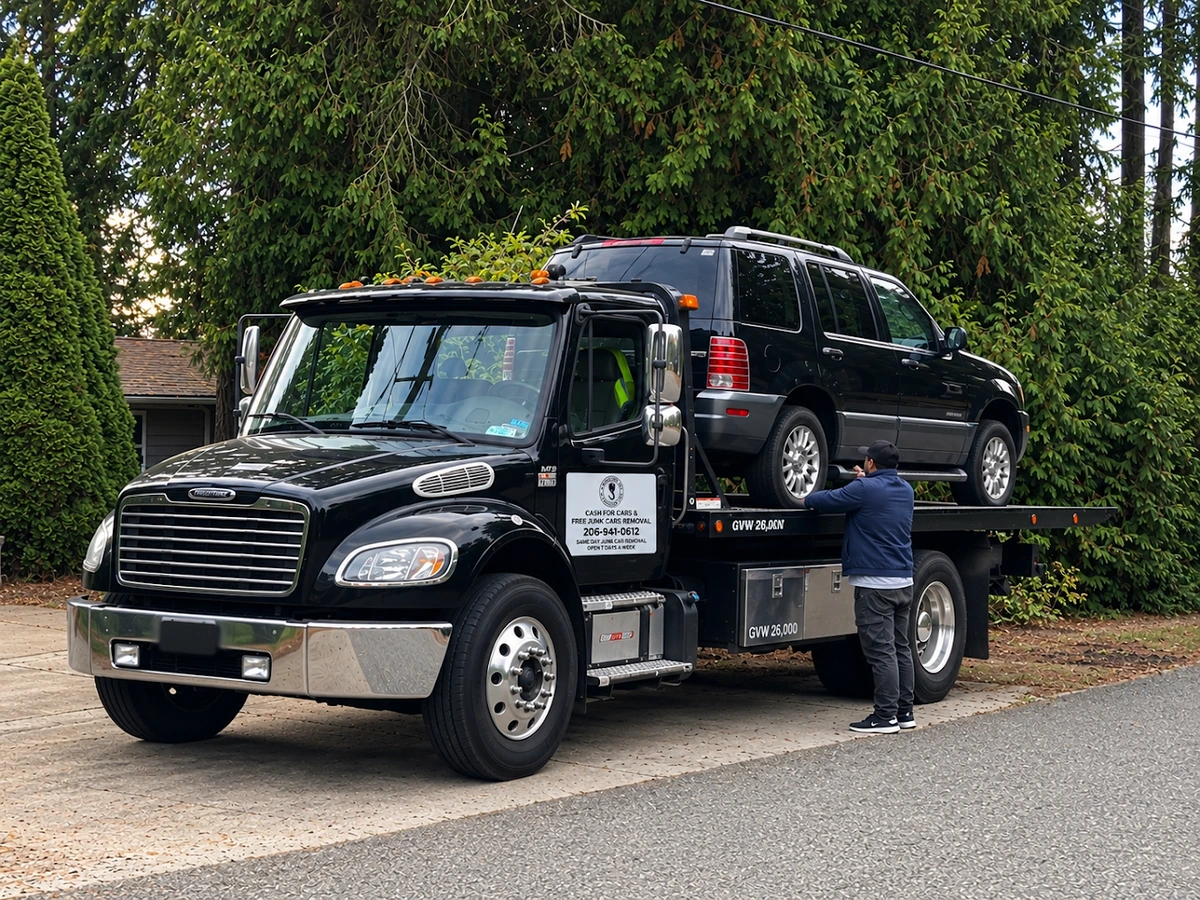
Our part is simple to describe. We tow your car to an auto steel recycler. The fluids are drained, tires and batteries are removed, and the car is crushed and melted down. Ecology’s Vehicle Recycling Manual (guidance for businesses, 2017) describes drip pads and removal of refrigerants, mercury switches, lead wheel weights, fuel and batteries.
See what happens after your car is towed away for the full path.
What we will not claim
- A percentage. You will see “X percent of a car is recyclable” around the web. We have no verified figure for it, so we leave it out. A number on a junk car site is not evidence, including ours.
- A carbon number. Whether replacing an old car helps depends on what you replace it with, how much you drive and how the old car is treated. We do not have numbers for your case.
- That recycling beats reuse. A safe car that someone can still drive may be the better outcome. If yours is that car, consider selling it to a driver.
Hybrids and EVs add their own questions. Most components of lithium-ion batteries can be recycled, the Department of Energy says, “but the cost of material recovery remains a challenge for the industry.” See dead hybrid or EV options.
What you can do today
- If the car leaks, catch the drip with a pan and keep it out of drains. Read leaks before pickup.
- Do not pour fluids on the ground or into storm drains.
- If a spill reaches water, report it right away. Ecology lists the numbers: 1-800-258-5990 and 1-800-424-8802.
- Do not leave the car somewhere and walk away.
- Pick a buyer whose license you can check. Our guide on checking a hulk hauler license shows how.
When you are ready for the car to go, here is how we do it. See also our license page.
Common questions
Official sources
- RCW 46.55.230: Junk vehicles on private property
- Washington Ecology: Publication 25-04-004
- WAC 173-303-522: Spent antifreeze
- Washington Ecology: Report a spill
- Washington Ecology: Vehicle Recycling Manual, Publication 97-433
- RCW 70A.205.505: Vehicle battery disposal
- RCW 70A.205.400: Tire disposal penalty
- US EPA: Regulatory requirements for MVAC system servicing
- US DOE AFDC: Batteries for electric vehicles
- Seattle SDCI: Junk storage, cars and illegal dumping rules
This post summarizes official Washington guidance as of November 2, 2026. It is general information, not legal or tax advice. Rules and fees can change, so check the sources above for your situation.
Keep reading
- Washington Junk Car Seller’s GuideEvery guide, sorted by where you are in the decision
- Washington Junk Car Paperwork GuideThe documents you need before pickup
- Old Oil and Antifreeze: Disposal in Washington
- How to Get Rid of Old Tires in Washington
- How to Dispose of a Car Battery in Washington
- Car Refrigerant and Junking: What the Rules Say
- Dead Hybrid or EV: What Are Your Options in Washington?
- Junk Car Terms Explained: A Plain-English Glossary
4.9 out of 5 from 160 Google reviews · Licensed & insured · 20+ years in business
They made it so easy and fast! I called them gave them all the details and they came within the hour towed the car and gave us cash on the spot will definitely recommend them :)
Very fast service. The tow truck driver was very skilled at getting my SUV out of a tight spot. I appreciate how easy it was to work with this company. Highly recommend 💞
Fast same day service. I just had to make sure we had the title and the truck was clean and we were good to go! Thanks for getting rid of our old truck for free.
If you have any questions please call us at 206-941-0612